
Check In for Tax Time: Reviewing Your Aircraft Usage Before Year-End

Angel Houck says October is the month to pull your flight logs because if your Qualified Business Use is short, you still have time to fix it. Wait until December and you don't.
As we roll into October, it is a good time to review your aircraft usage for 2026 and make sure you are on track for your tax goals. There are a few things you can do this time of year to avoid unwanted surprises when tax time comes.
If you took bonus depreciation on your aircraft in a previous year, or plan to take bonus depreciation this year, now is a great time to check your Qualified Business Use (QBU). To qualify for accelerated depreciation methods, such as bonus depreciation, an aircraft must be predominantly used in QBU of the business every year.
QBU is defined differently for different businesses, and it is important to understand what is required. By reviewing your logs now and meeting with your aviation tax advisor, you can identify any usage shortfalls and plan accordingly for year-end travel.
It is also a good idea to review the flight documentation and make sure you have what you need in case of an audit. In my previous article, Flight Documentation (March 2025), I discussed the documentation requirements for business use of the aircraft. It is much easier to pull this information while it is recent and fresh in your mind, and it gives you time to add additional information if needed.
Reviewing your flight logs and tax records now will make year-end much easier. You will have time to adjust your usage if there are shortfalls on your QBU, and you will have less to do at year-end when it is time to provide the information to your tax advisor. I highly recommend setting aside time with your aviation tax advisor to review your year-to-date activity and avoid any unwanted surprises.

The Fed Acts: What the Rate Increase Means for Aircraft Loan Interest Rates
Mike Smith breaks down the Fed's first rate hike in three years and explains why the more important number isn't the fed funds rate at all, it's the 10-Year Treasury that already crossed 5%.
As was widely anticipated, the Federal Reserve Open Market Committee (FOMC) increased its target rate by 0.25% at the conclusion of its meeting on September 16. This was the first rate increase in over 3 years, and in reading the tea leaves after the meeting, we should expect another 0.25% increase by the FOMC before the end of the year.
This is a material change in posture compared to where we started in 2026. At the start of the year, the market expected rate cuts from the FOMC. What happened? Ultimately, it goes back to the Federal Reserve’s “dual mandate” of maximum employment and price stability (defined as a 2% inflation rate). And as we all know, inflation continues to run a little hot.
With Chair Kevin Warsh now at the helm, FOMC leaves no gray area on where it’s focused. As stated in the official statement at the end of the meeting, “Inflation remains elevated. Today’s policy action will support a timelier return to the Committee’s 2 percent goal. The Committee will deliver price stability.” (Emphasis added).
In fact, the FOMC’s official statement ( available here ) was only 132 words long, which was half the size of the statement at the September meeting last year.
So what does that mean for aircraft loan interest rates? Will we see an increase there? If we look back at the 10-Year Treasury rate, the market started pricing in these increases earlier this year, as seen in the graph below, which shows the 10-year from January 1 to September 16. In fact, the 10-year surpassed 5.00% for the first time since before the Great Recession.
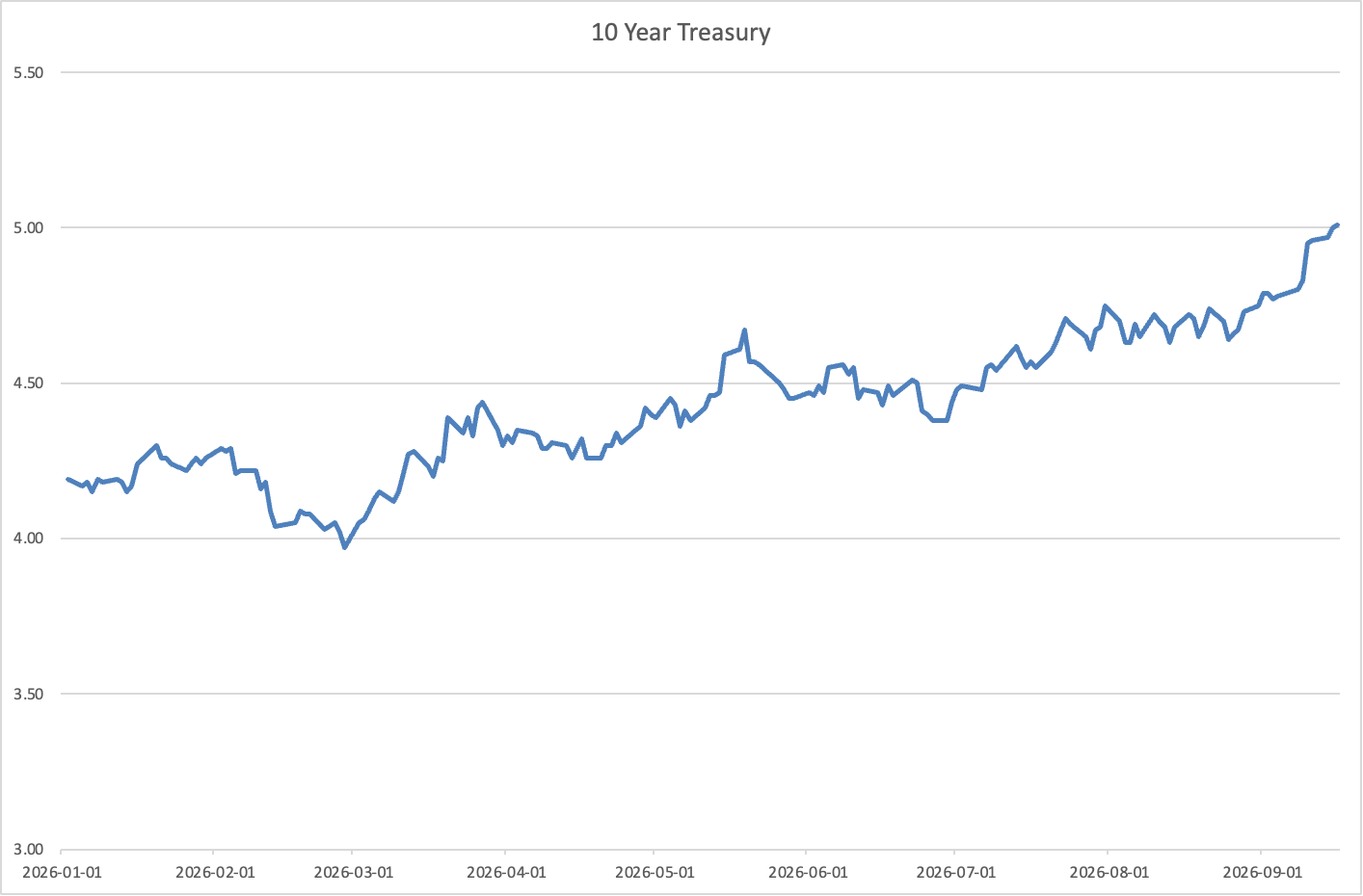
This data means it’s not a question of whether rates will go up because the FOMC increased its rate. In reality, market interest rates have already gone up. The question is where rates will go from here, and that’s where things get a little more fuzzy. It all depends. If the FOMC remains focused on price stability, as suggested in their statement, expect more upward adjustments until they’re comfortable with the inflation rate.
The FOMC meets two more times this year, at the end of October and in early December. As each meeting occurs, we’ll all have a better understanding of what to expect going forward.

What Am I Waiving? Understanding Waivers of Subrogation in Aircraft Insurance
Tom Hauge explains what you're actually giving up when you sign a waiver of subrogation and why that hangar agreement on your desk deserves a closer read before your signature goes on it.
If you are a current aviation insurance policyholder or have been around aviation insurance, you have likely heard the term ‘waiver of subrogation’ (WOS). A waiver is a vehicle, when granted to an individual, airport, insured entity, hangar lessor, training provider, etc., whereby the insurance carrier involved in a claim/loss gives up its right to subrogate a loss back to the waiver recipient. While it is not very common for a pilot individually or a training organization to beto be subrogated against, it’s always best practice to receive a waiver when you are engaged in commercial activity as one of the noted parties.
If you are hangaring your aircraft at its base of operation with an FBO or standalone hangar owner/lessor – you will most likely be asked to execute a hangaring agreement. The same holds true for a training contract if you are engaging a training provider to administer initial or recurrent training in a turbine aircraft. These noted agreements will almost always require the signing party receiving the service to list the hangaring entity or trainer on the aircraft insurance policy as an additional insured and provide a waiver of subrogation. The waiver (when in place) prohibits the insurance carrier (underwriter) from subrogating a loss even in times of negligence by the party causing the loss. In today’s insurance market, it is somewhat common for the insurer to charge the policyholder a premium when offering a waiver of subrogation, specifically in hangaring agreements. The reason for this charge, at least in the case of hangaring entities, is that the insurer is now shouldered with responsibility for covering the loss even when its insured party (aircraft owner) has no culpability in the loss occurring (think a damaged aircraft caused by the FBO but no one admitted fault). Typically, premium-bearing waivers are only related to hangaring and not training providers – but all policies can be different, so it’s best to have your broker explain any premium-bearing items specific to your policy when a formal agreement might be tendered for you to sign as the aircraft owner. All agreements you, as the aircraft owner, execute should be reviewed by your broker and underwriting carrier to confirm compliance with the insurance policy and that any noted insuring agreements you agree to are duly executed within the policy.
The details here definitely matter, especially if there is a loss that occurs in a hangaring arrangement and each party starts pointing fingers at each other.

Kenn Ricci Plays with Fire
Dustin Cordier agrees with most of what Kenn Ricci put on the table but argues that splitting operators off into their own lobbying group would hand the airlines and ALPA the easiest target they've ever had.
Kenn Ricci’s recent conversation on The VIP Seat podcast was recorded inside the 747 mockup at The Jet Business in London, right after a planned interview about a deal. Ricci asked the hosts to keep recording because he had something else he wanted to say, and they warned their audience up front that it would probably be a lightning rod, which turned out to be an understatement.
Ricci has earned the right to be heard. He chairs Flexjet and owns and manages more than a dozen companies across fractional ownership, jet cards, charter, maintenance, engineering, management, and brokerage, and in March he shared the SDC2026 keynote stage in Cleveland with Ed Bolen. He’s fearless and persistent, and when he calls himself a “40-year overnight success story,” he isn’t exaggerating. His read on the squeeze operators are feeling deserves our attention, though the remedy he’s floating could fracture the association that represents all of us.
He’s right about the problem
Anyone who has sold airplanes for a living will recognize the market he describes. Flexjet has waiting lists on three aircraft types, and customers call asking to move up the list instead of asking for a discount. Buying has gone the other direction. OEM order books run three years out, so manufacturers have little reason to deal, and they’re steering their business models toward service and subscription revenue. Private equity has rolled up FBOs and maintenance shops along the way, and in Ricci’s telling that has pushed costs up and service down.
He put four ideas on the table and called them trial balloons. The first targets source data. Ricci says aircraft buyers don’t receive wiring diagrams and full repair documentation despite FAA requirements, and without that data nobody can develop PMA parts or alternative repair methods, something the airlines get routinely. The second is an operator-only lobbying group. The third goes after special event fees, which he called “criminal.” He wants operators to align with airport authorities, since those fees are charged for using airport infrastructure and could fund ramp space and adjacent land instead of FBO returns. The fourth is a SPAC of roughly $300 million to back PMA and aftermarket competitors, on the condition that anything it funds stays available to every operator.
He’s even told the FBO chains to their faces that operators are starting to hate them. If you’ve paid a graduation-weekend event fee in New York, you probably nodded along.
His list leaves out the issue most Part 91 operators would put first, which is privacy. Registry data can be paired with flight tracking to connect an aircraft’s movements to its owner, and whole-aircraft owners spend real effort shielding themselves through LLCs, trusts, LADD and PIA. Fractional customers fly shared aircraft under the operator’s call sign and get much of that anonymity built in. That’s worth noticing, since the gap he skipped is the one that matters least to his own customers.
I support most of what he’s proposing, and my concern sits almost entirely with the second idea.
Why an operator-only lobby burns us
Ricci argues that FBOs, MROs, OEMs, and operators no longer share the same interests, so operators need a voice willing to push against other parts of the industry. The hosts pushed back that NBAA can’t easily play that messy middle, and Ricci answered that nobody needed a messy middle until a couple of years ago, when the FBOs created the need. His next step is asking the existing associations what they plan to do, and if he doesn’t like the answer, he says he’ll lead the coalition himself.
In the first quarter of 2026, Delta reported $1.7 million in federal lobbying, United $1.27 million, American $1.16 million, and Airlines for America another $1.04 million. NBAA reported $380,000 for the same quarter and $420,000 for the next, which means Delta alone outspent our entire association more than four to one.
ALPA adds a second front. The pilots’ union spars with the carriers at the bargaining table, then lines up with them whenever charter or fractional flying starts to look like airline competition. We saw the playbook in the fight over JSX’s public charter model, where the argument was that it’s really an airline and should fly under Part 121. A coalition of big fractional and charter fleets operating apart from the rest of business aviation would hand them the easiest target they’ve ever had.
“We’re all starting to hate you.”
Kenn Ricci, to the FBO chains
Business aviation has always been outspent in Washington, and our wins have come from how many districts we touch. Our industry reaches thousands of airports and nearly every congressional district, so when NBAA stands alongside AOPA, NATA, GAMA and EAA, members of Congress hear from employers in their own backyards. That’s how we beat user fees in 2007, and it’s why FAA reauthorization passed without ATC privatization. An operator-only group trades that reach for a coalition that speaks mainly for a handful of large fleets.
There’s a funding problem too. OEMs and FBO chains are among NBAA’s largest BACE exhibitors and sponsors, and an operator faction calling their fees criminal in public gives them every reason to spend elsewhere. That would weaken the association on everything else we count on it for, from tax policy to airport access.
A better flight plan
I’d rather see Ricci’s grievances carried inside NBAA by an operator coalition chartered by the board, with its own seat at the table and its own published positions on the issues where operators and service providers genuinely disagree.
Privacy belongs at the top of the list. It’s the issue Part 91 operators raise first, and it already shows what a united front can do. In a July 31 letter, AOPA, EAA, NBAA and Vertical Aviation International jointly asked the FAA to tighten limits on releasing owners’ personal information as it implements Section 803 of the FAA Reauthorization Act of 2024. Source data comes right behind it, since it rests on airworthiness requirements already on the books, and I can’t picture any member wanting to argue in public for withholding required documentation. Event fees would come next, pursued through the federal grant assurances that require airports taking AIP money to keep fees reasonable and not unjustly discriminatory, with Part 16 complaints as the enforcement path. That route gets Ricci most of what he’s after through a mechanism that holds up to scrutiny, and it protects the small Part 135 operator as much as it protects Flexjet. The coalition could also run a PMA and aftermarket clearinghouse so operators can share what’s working, which Ricci was already encouraging on the podcast.
For this to be more than a gesture, the coalition needs a deadline for publishing its first positions, so it doesn’t drift into a working group that meets quarterly and produces nothing. It also needs voices beyond the big fleets, since the corporate flight departments and small charter operators at NBAA’s core carry the political weight that makes any of this matter. That structure gives Ricci a platform with real reach and keeps the airlines and ALPA from exploiting a split.
Bring it to Las Vegas
NBAA-BACE runs October 20 to 22 at the Las Vegas Convention Center. If your operation has been hit with event fees or stonewalled on documentation, bring the specifics and put them in front of NBAA staff while you’re there. Ricci has put the issue on the table, and the operators who show up with real numbers will shape how this plays out.
Full disclosure: I serve as Vice Chair of NBAA’s Business Aviation Management Committee. The views here are my own.
Source: The VIP Seat, interview with Kenn Ricci recorded at The Jet Business, London. Watch the episode