
Sale for Resale Exemptions: A Smart Aircraft Tax Strategy

Angel Houck breaks down the sale for resale exemption — a potentially valuable (and misunderstood) tax planning strategy — and what you need to know before your next purchase.
Sales and use tax on aircraft can be a material number, and proper planning can be very valuable. I have written about some of the exemptions out there for sales and use tax in previous articles, like State Tax Exemptions and State Taxes –What to Know. This time around, I want to focus on sales for resale exemptions.
Due to FAA regulations, it is common to see an aircraft operated under a dry lease. For our purposes here, a dry lease is a lease of tangible property without an operator. In many states, this type of lease is subject to sales tax. Often, if an aircraft is purchased with the intent to be exclusively operated under a dry lease (or leases), the purchase can qualify as a sale for resale. This means that sales or use tax is not due on the original purchase of the aircraft, but instead, tax is due on the lease payments over time.
Each state has its own set of rules as to what qualifies as a sale for resale and how the tax is applied. In states that allow this type of exemption, the most common conditions are:
- The aircraft must be purchased exclusively for leasing.
- The purchaser must register with the state as a reseller and obtain a resale license prior to purchasing the aircraft.
- The lease must be treated as an arm’s-length transaction, meaning that a fair market rate is charged and the payments are collected on time.
It is especially important to review the rules and the validity of the lease if the lessor and lessee are related parties. Some states, like Colorado, will reject many leases between related parties and impose tax at the time of purchase. Other states, such as Wisconsin, will not recognize the lease if it is between an entity that is disregarded for income tax purposes and its parent.
If a sale for resale exemption is used, the aircraft must continue to be treated as leased property for as long as the aircraft is owned. If the usage changes and the aircraft is no longer leased, use tax will likely be due on its fair market value. If the aircraft’s home base changes to another state, you must re-evaluate whether the exemption still applies.
The takeaway here is that the sale for resale is a valid tax planning strategy in many states for many purchases. However, it will not always apply. Consult your aviation tax advisor early in the process to understand your options and maintain compliance.

Does Your Aircraft Insurance Submission Tell the Whole Story?
Tom Hauge pulls back the curtain on what goes into an aircraft insurance submission — and why the details you share (or don't) could have a real impact on your coverage and premiums.
The means by which your insurance broker approaches an insurance underwriting carrier for a quote is via an insurance ‘submission’. The submission is typically a written document of a page or two that contains pertinent information on your risk for underwriting evaluation. In the aircraft hull and liability policy segment, the submission will almost always contain pilot information, the limits and coverages being requested, along with ancillary details concerning what type of policy the broker is seeking (i.e., pleasure use or commercial use).
Other information useful to underwriting includes details about the aircraft itself, including its N number, year of manufacture, insured value, and make/model. Of primary importance to most underwriters is centered around how you operate, where you intend to operate (territory), and the frequency of operations.
Pilot experience details – in addition to your logged hours in various platforms – will almost always outline your training regimen, including whether you attend formal recurrent/initial training for the aircraft being quoted. I always recommend that the pilot details include as much information as possible about that pilot beyond the hourly experience level, certificates, and ratings. Pilot experience and overall pilot details will largely drive the premium associated with a pleasure and business use policy. Pilot details are also critical on professionally flown aircraft, making it imperative that the pilot data provided to underwriting is complete and robust.
In the single-engine piston class, the submission may not be as robust, nor would a substantial amount of additional information generally move the insurance needle a lot in this lower-value class on insurance terms. However, when you get into turbo-prop and jet aircraft that are owner-flown with higher hull values,that submission information can make a difference in the insurance underwriting applied to your risk. I have many clients who insist on submitting a ‘white paper’ type document, which essentially is an autobiography of sorts as to their approach to flying, their health metrics, and their overall approach to risk management. These white paper documents on certain risks (e.g., older pilots) can have an impact on their insurability and the underwriter’s comfort level when quoting their policy.
It is always a good idea to engage your insurance broker on this topic to see whether a white paper or supplemental information might improve in your submission. I always say you can’t over-communicate on this subject, –that little bit of extra time you spend completing insurance paperwork each year to tell your story may help you in the long run.

Analyzing Potential Aircraft Liability: Who's Really Responsible?
John Farrish breaks down the three distinct buckets of aircraft liability — and reveals why the Operator, not the Owner, carries the real risk. Think owning the plane makes you the most liable? Think again.
Business aviation is incredibly safe – you are more likely to be injured in a car accident on the way to the airport than onboard the plane itself. But when accidents do happen, the liability can be catastrophic.
In this multi-part series on liability, we will broadly cover the potential liabilities that lurk out there and what can be done about them.
Who Can Be Liable?
Who could potentially be liable for the consequences of an aircraft incident? Any analysis of liability needs to start here. There are three distinct but intertwined "buckets" of potential liability:
Owner:
Most clients assume the owner of the plane has the most liability. They plan to "isolate" the liability by keeping everything aircraft-related in a special purpose entity for "protection." This is doubly wrong.
Merely owning a plane comes with surprisingly little liability. If you buy a plane, park it in the hangar, and never use it, the plane can't get you into too much trouble. It doesn't crawl out of the hangar at night and bite people; it doesn't taxi around and hit things, and it surely doesn't fly by itself into accidents. Rather, the liability comes from operating the plane.
While the Owner and the Operator are occasionally the same person or entity, they are two distinct and different roles when it comes to liability.
Further, if you operate the plane through the special-purpose Owner entity, you are unwittingly creating even more liability for yourself by likely engaging in illegal charter flights (even if only for yourself). See this article for a refresher.
So if the Owner isn't the party that's primarily liable, who is?
Pilot:
Roughly 70-80% → 70–80% of private aviation accidents are attributed to pilot error. This makes the pilot the clearest target for liability. However, most pilots' pockets aren't as deep as the owners', so personal injury lawyers wouldn’t stop their liability search there. The exception, of course, is owners who fly and operate their own aircraft.
Operator:
The person (or entity) with the lion's share of the liability is the Operator. This is the person with "Operational Control" of the aircraft, defined as "with respect to a flight, means the exercise of authority of initiating, conducting, or terminating a flight." This includes ultimate responsibility for crewing the plane, maintaining it, and deciding where it goes and when. The Operator is typically liable for the pilot’s faults.
Through poor planning, shoddy paperwork, and sloppy implementation, the lines of operational control can become very gray very quickly. This can open the door to even more liability and potential unlicensed charter flights.
The Operator is typically either an individual if the aircraft is essentially only a personal-use plane, or an operating business that uses the plane for principals, employees, and guests. Again, the Operator can never be a special-purpose entity.
Since the Operator will always be a real person or a real business, acknowledging the Operator's liability and planning for it is key when setting up the ownership/operational structure for plane owners. In a later issue of The Plane Truth, we will also analyze what it looks like for a charter company to act as the owner's operator and absorb most of the liability.
(For deeper analysis on Operational Control, I urge you to download the National Business Aviation Association's "Operational Control Handbook," which delves into this nuanced subject.)
While liability can't be ignored by owners, frankly, it is only one consideration when setting up an ownership structure. It should be integrated hand in hand with tax planning, practical operational issues, and real-life facts about who will pay for the plane's use and how it will be used.
Next month, we will cover potential plans to address liability and best practices to keep liability theoretical.
This article is not intended, nor should it be construed or relied upon, as legal advice. The comments, recommendations, and analysis expressed in this article are those of the individual author, John Farrish, and are purely informational. Each aircraft owner's situation is unique and requires its own thorough discussion and analysis. This article does not create an attorney-client relationship between you and the author or his law firm. If specific legal information is needed, each person should retain and consult an attorney with knowledge of the subject matter.

Are Aircraft Loan Interest Rates Up or Down? The Answer Is Yes.
Mike Smith tackles the question every borrower is asking right now — are rates up or down? The answer is more nuanced than you think, and understanding it could shape your next aircraft purchase decision.
On a recent loan transaction, I was discussing the final loan structure with our borrower when the question of "aren't rates going down?" came up. This was a perfect time for that question, because I knew I had promised our Plane Truth readers that I'd touch on the interest rate environment in my March article.
For those who have been faithful readers (and if this is your first time, welcome, and please tell your friends), you'll recall that in 2025, when I touched on interest rates, I looked at the 10-Year US Treasury rate in our discussions. I reference the 10-Year Treasury because it's a good trend indicator of where rates are going, which is the bigger picture I want to maintain when discussing financing conditions here.
Where Rates Have Been
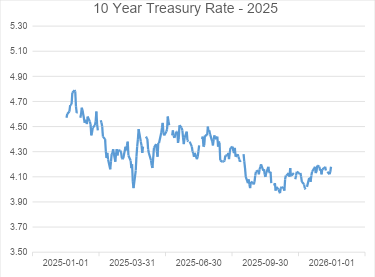
For example, looking back at January 2, 2025, the 10-year Treasury rate was 4.57%. By June 30, it was 4.24%, and by the end of 2025, it was 4.14%. For those who are visual learners, here's what that looked like in graph form:
Where Rates Are Now
Moving into 2026, from January 2 to March 11, rates went from 4.19% to 4.21%. But note in the graph below that the 10-year rate bottomed out at 3.97% on February 27.
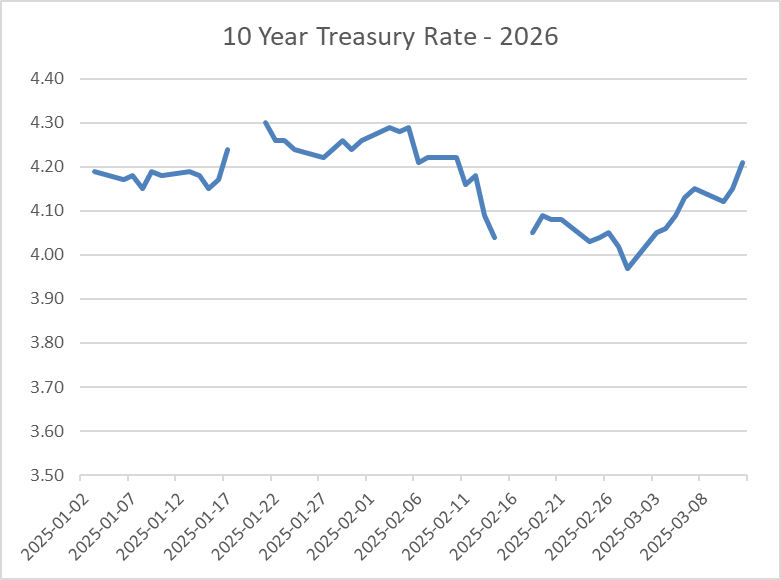
So, did rates go down? Yes. Through 2025 and into 2026, rates declined when using the 10-Year Treasury as our benchmark. But since the end of February, rates have actually gone up.
What's Driving the Volatility
Rates like the 10-Year Treasury (and the root drivers of aircraft loan rates ) are largely driven by market dynamics. Longer-term rates like the 10-Year Treasury effectively act as a proxy for where the market believes the economy is heading ( higher rates = a stronger economy or higher inflation, for example). This recent increase in rates has a couple of driving factors, mostly tied to geopolitical dynamics like what's going on in the Gulf. Over time, higher energy prices result in higher inflation, which leads to less rate movement by the Federal Reserve.
The Bottom Line
So, are rates down? Yes. Are rates up? Yes. The market is figuring out a lot right now, so expect some of this rate volatility to continue as the unknowns are sorted out.

Glass Cockpit, Foggy Business: Why Your Scorecard Is Your Panel
Dustin Cordier uses the KC-135R's glass cockpit transition to expose the real data problem facing BizAv businesses today — it's not too little information, it's measuring the wrong things.
When the KC-135R transitioned from steam gauges to a glass cockpit, something unexpected happened on both ends of the experience spectrum.
The old timers, pilots who'd spent careers trusting six analog instruments, looked at the new displays and blocked most of it out. They flew the airplane the old way: pitch, power, trim, crosscheck. But they were leaving situational awareness on the table.
The new guys did the opposite. They loved the data. Every readout, every trend line, every system parameter. They wanted it all. And their ability to actually fly the airplane suffered for it.
The lesson wasn't that data is good or bad. Neither extreme produces a great pilot. What you need is someone with enough situational awareness to understand what's happening inside the aircraft, and the experience to know which variables matter right now and what to do about them.
That's exactly where most businesses are today.
A few years ago, the conversation was simple: use data. Most owners were flying on gut feel with nothing on the panel. Today, the problem has flipped. Especially in high-tempo BizAv operations like scheduling, dispatch, and charter management, there's data everywhere. Multiple platforms. Endless reports. And when the Visionary asks, "Are we actually winning?" nobody answers cleanly.
That's not an information problem. That's a measurement problem.
In Data (EOS Traction Library), Mark O'Donnell, Mike Stanley, and Angela Kalemis draw a line that changes the conversation: numbers aren't about numbers. They're about tracking behaviors and habits in a measurable way so you can get what you want out of your business.
The solution is a Scorecard: five to fifteen weekly numbers that give you genuine situational awareness without the cockpit noise. For a dispatch operation, those might be the quotes-to-contracts ratio, on-time departure rate, cost-per-leg variance, and repeat booking frequency. Owned. Reviewed weekly. Acted upon.
Work backward from the outcomes that matter: new customers, existing orders, client satisfaction, profitability, and cash. Find the leading indicators that predict them. That's your glass panel configured right.
Now layer in AI, and the stakes get higher, not lower. Automation is only as smart as what you feed it. A dispatch operation running AI-assisted scheduling on dirty data, wrong inputs, inconsistent definitions, numbers nobody owns, doesn't get efficient. It gets efficiently wrong, at scale, faster than any human could manage. If you want AI to drive better decisions, you need clean data upstream. That means a culture where measurement is disciplined, ownership is clear, and the numbers actually reflect reality. Garbage in, catastrophic out. The aircraft doesn't care how sophisticated your autopilot is if the altimeter is lying.
The goal is a team with enough data literacy to read the instruments and the judgment to know which ones to trust when it counts.
Data equals freedom and confidence, but only when it's the right data, kept clean, in the right hands.
Don't block out the panel. Don't chase every readout. And never hand the controls to an autopilot you haven't calibrated.
Fly the airplane.