

On a recent loan transaction, I was discussing the final loan structure with our borrower when the question of "aren't rates going down?" came up. This was a perfect time for that question, because I knew I had promised our Plane Truth readers that I'd touch on the interest rate environment in my March article.
For those who have been faithful readers (and if this is your first time, welcome, and please tell your friends), you'll recall that in 2025, when I touched on interest rates, I looked at the 10-Year US Treasury rate in our discussions. I reference the 10-Year Treasury because it's a good trend indicator of where rates are going, which is the bigger picture I want to maintain when discussing financing conditions here.
Where Rates Have Been
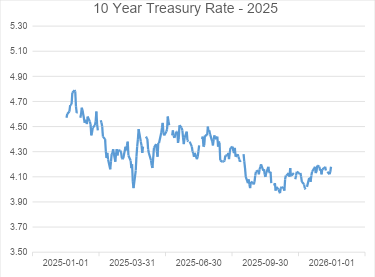
For example, looking back at January 2, 2025, the 10-year Treasury rate was 4.57%. By June 30, it was 4.24%, and by the end of 2025, it was 4.14%. For those who are visual learners, here's what that looked like in graph form:
Where Rates Are Now
Moving into 2026, from January 2 to March 11, rates went from 4.19% to 4.21%. But note in the graph below that the 10-year rate bottomed out at 3.97% on February 27.
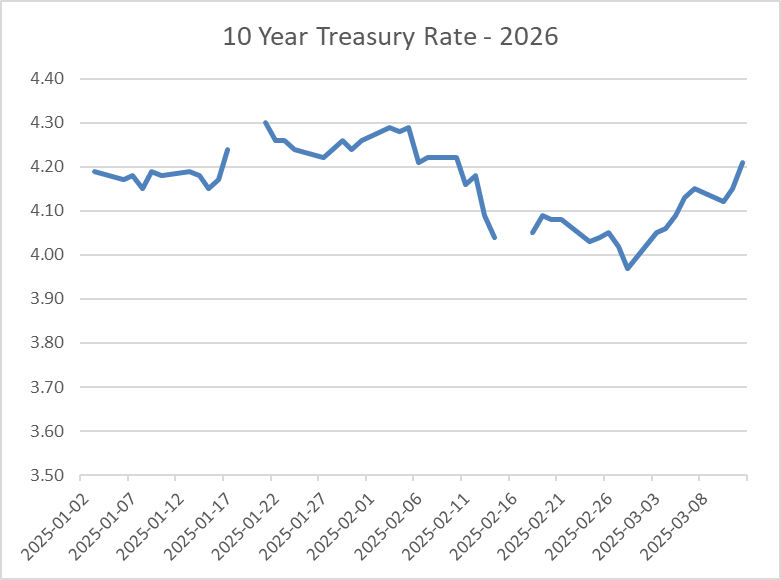
So, did rates go down? Yes. Through 2025 and into 2026, rates declined when using the 10-Year Treasury as our benchmark. But since the end of February, rates have actually gone up.
What's Driving the Volatility
Rates like the 10-Year Treasury (and the root drivers of aircraft loan rates ) are largely driven by market dynamics. Longer-term rates like the 10-Year Treasury effectively act as a proxy for where the market believes the economy is heading ( higher rates = a stronger economy or higher inflation, for example). This recent increase in rates has a couple of driving factors, mostly tied to geopolitical dynamics like what's going on in the Gulf. Over time, higher energy prices result in higher inflation, which leads to less rate movement by the Federal Reserve.
The Bottom Line
So, are rates down? Yes. Are rates up? Yes. The market is figuring out a lot right now, so expect some of this rate volatility to continue as the unknowns are sorted out.